

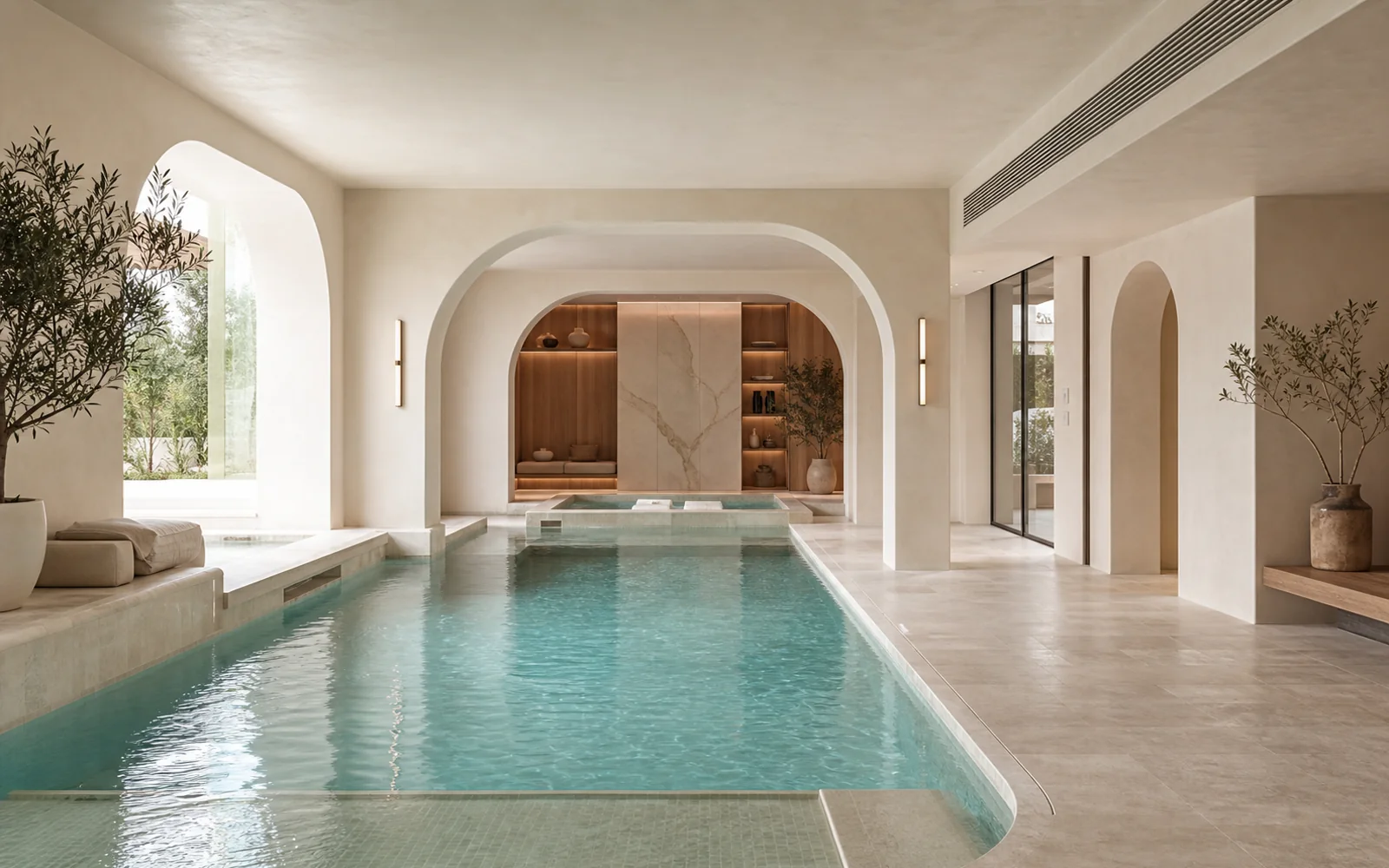
Indoor Pool Construction: The Engineering of Four-Season Use
What makes a covered pool comfortable year-round is not the water itself but the volume that surrounds it. When humidity management, ventilation, heating and building physics are engineered correctly, an indoor pool becomes a true four-season living space.
What makes a covered pool comfortable year-round is not the water itself but the volume that surrounds it. When humidity management, ventilation, heating and building physics are engineered correctly, an indoor pool becomes a true four-season living space.
An indoor pool is not simply putting a roof over a pool. When the water surface is enclosed in a closed volume, the air, temperature and humidity balance of that volume is completely under your control; This brings with it a completely different engineering discipline. The moisture that evaporates in an outdoor pool mixes with the atmosphere. In a closed space, this moisture remains in the volume, condenses on the building surfaces, and if not managed correctly, threatens both comfort and the building itself.
For this reason, we start the indoor pool project from the air volume, not the water volume. Thermal insulation of the space where the pool is located, ventilation strategy, dehumidification capacity and the behavior of the surface materials against moisture must be considered together at the first sketch stage. The most basic principle we have acquired in the indoor pool projects we have carried out since 1993 is this: success in an indoor pool is hidden not in the design of the water, but in the design of the environment that contains that water.
Season independence usually lies behind choosing an indoor pool. A pool that can be used in winter, rain and wind; It offers a swimming experience at a constant temperature, unaffected by outside weather conditions. However, making this comfort permanent depends on the correct dimensioning of the mechanical and structural systems from the very beginning. A poorly designed indoor pool can quickly turn into the opposite experience with condensation, mold and corrosion problems.
There is constant evaporation in a closed pool area. Humidity rising from the water surface pushes the indoor air towards saturation. This moist air turns into water droplets when it comes into contact with a colder surface; this is called condensation. Glass surfaces, external walls, under the roof and metal parts are the most common points where condensation occurs. Condensation is not just an aesthetic defect; Constant wetness means material fatigue, mold growth and long-term structural damage.
The basis for managing condensation is to keep the relative humidity in the space within a comfortable and safe range. When it remains below this band, evaporation from the water surface accelerates and energy consumption increases; When you go above it, the risk of condensation and mold begins. The correct balance is established by keeping the indoor air temperature in a harmonious relationship with the water temperature. As a general principle, keeping the indoor air slightly warmer than the water temperature slows down evaporation and increases comfort.
Another critical point is the thermal behavior of the surfaces most susceptible to condensation. Especially large glass facades create the weakest heat barrier between the outdoor environment and the space. In order to prevent the interior of these surfaces from cooling, glass systems with high insulation performance are selected and warm air flow is planned across these surfaces. Air directed in front of the glass prevents fogging and dripping by keeping the surface temperature above the dew point.
The heart of climate control in an indoor pool is the ventilation and dehumidification system. The aim is to remove excess moisture from the space and provide fresh and clean air inside, while not wasting heat energy. The solution that meets these three goals at the same time is a dehumidification and ventilation unit specifically sized for the space.
The dehumidification unit takes in the indoor air, separates the moisture from water by condensing it, and returns the dried air to the environment. In modern systems, the heat extracted from the air during this process is returned to the space or water; thus, the dehumidification process also turns into an energy recovery process. This is one of the most important factors that determine the operating cost of indoor pools and provides serious savings with the right device selection.
In ventilation design, the geometry of air distribution is at least as important as the device capacity. Exhaust vents are positioned towards surfaces where moist air accumulates and condensation is most likely, especially glass facades. Suction points are planned to collect air from areas where humidity rises. An incorrectly configured air distribution leaves dead zones, no matter how powerful the device, and condensation is inevitable in those areas. For this reason, the entire volume of the space is handled with the logic of air flow simulation in the project design.
There are two separate heating loads in an indoor pool: heating the water and heating the indoor air. These two loads are related but met by different systems. Water heating is usually provided by heat pump, heat exchanger or combined systems. Space heating works integrated with the ventilation system; The fresh air given inside is brought to comfort temperature and blown out.
Heat pumps stand out in indoor pools in terms of energy efficiency. The heat pump collects low-level heat in the environment or outside air and transfers it to water, providing heat gain much higher than the electrical energy it consumes. This efficiency increases even more in a closed and insulated space, because the heated energy does not easily escape to the outside environment. Covering the water surface with a cover when not in use greatly reduces the heat lost through evaporation.
An issue that is often overlooked in heating design is the thermal insulation of the structure. No matter how powerful a heating system you install, a poorly insulated space will constantly lose heat and the systems will have to work non-stop. Therefore, the walls, floor, roof and especially the glass surfaces of the indoor pool area are evaluated with their insulation performance as a whole. The investment in insulation pays back many times over in energy bills throughout the operation.
The architectural identity of the indoor pool is largely determined by the glass surfaces and roof. Large glass facades bring natural light into the space, establish a visual connection with the external landscape and preserve the feeling of open air even in a closed volume. However, glass is also the thermally weakest link of the structure. Therefore, it is not possible to use single glass in indoor pools; Insulating glasses with high insulation performance, double or triple glazing, and filled gas are preferred.
Another determinant in glass selection is frame and seal systems that are resistant to humid and chlorinated environments. The air of the pool area is much more aggressive than in ordinary structures due to chlorine compounds and high humidity. It is essential for aluminum profiles to have a surface treatment suitable for these conditions and to select corrosion-resistant gaskets and fasteners for the long life of the system.
The roof system is designed for both insulation and condensation management. The under-roof surface is the point where the warmest and most humid air of the space rises; If this surface remains cold, condensation and dripping begins here. In the roof installation, insulation should be continuous, the under-roof surface temperature should be kept above the dew point and, if necessary, air circulation should be provided throughout this area. Openable roof or sliding closure systems provide flexibility of use by turning the pool into a semi-open area in the appropriate season.
An indoor pool is a multidisciplinary project at the intersection of architecture, mechanics and pool engineering. Running these three areas independently of each other is the source of the most common errors. It is a process that considers the pool separately, the ventilation separately, and the architecture separately; It produces conflicting solutions and problems arise only after the structure is completed. The right approach is to bring all disciplines together at the same table from the first day of design.
When starting an indoor pool project, we start by clarifying the purpose of use of the space, targeted water and air temperatures, architectural expectations and budget framework. Then, the moisture load, heat loss and ventilation needs of the space are calculated; These calculations guide device selection, insulation decisions and material preferences. This holistic approach is the basis of a facility that operates smoothly even after years.
Our engineering experience in pools, saunas, Turkish baths and spas since 1993 has repeatedly shown that invisible decisions determine visible comfort in an indoor pool. A well-designed indoor pool offers the freedom to swim in warm water while it's snowing outside, with low operating costs and a long-lasting structure. Making this holistic planning before turning your indoor pool idea into a project will ensure both your current comfort and future costs.
Image gallery
04 görsel
 01
01 02
02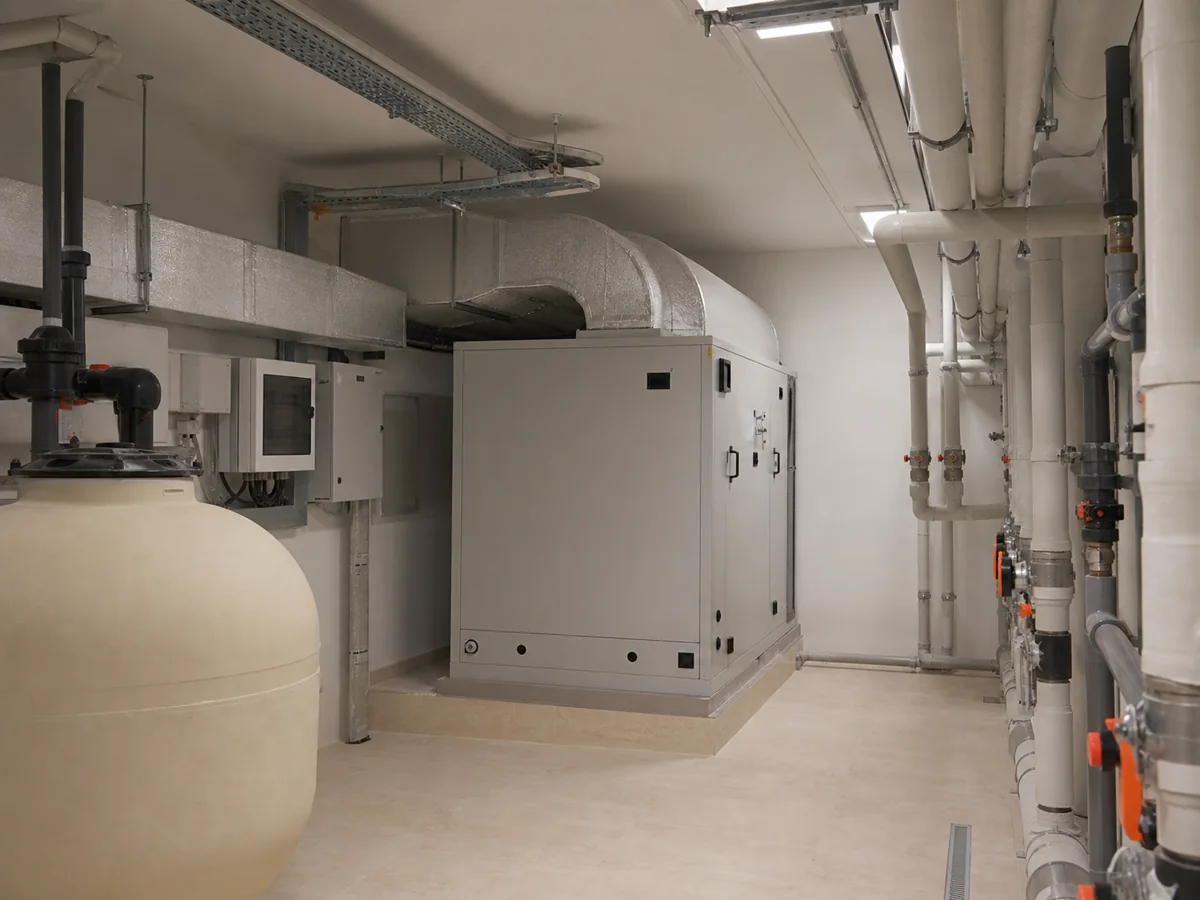 03
03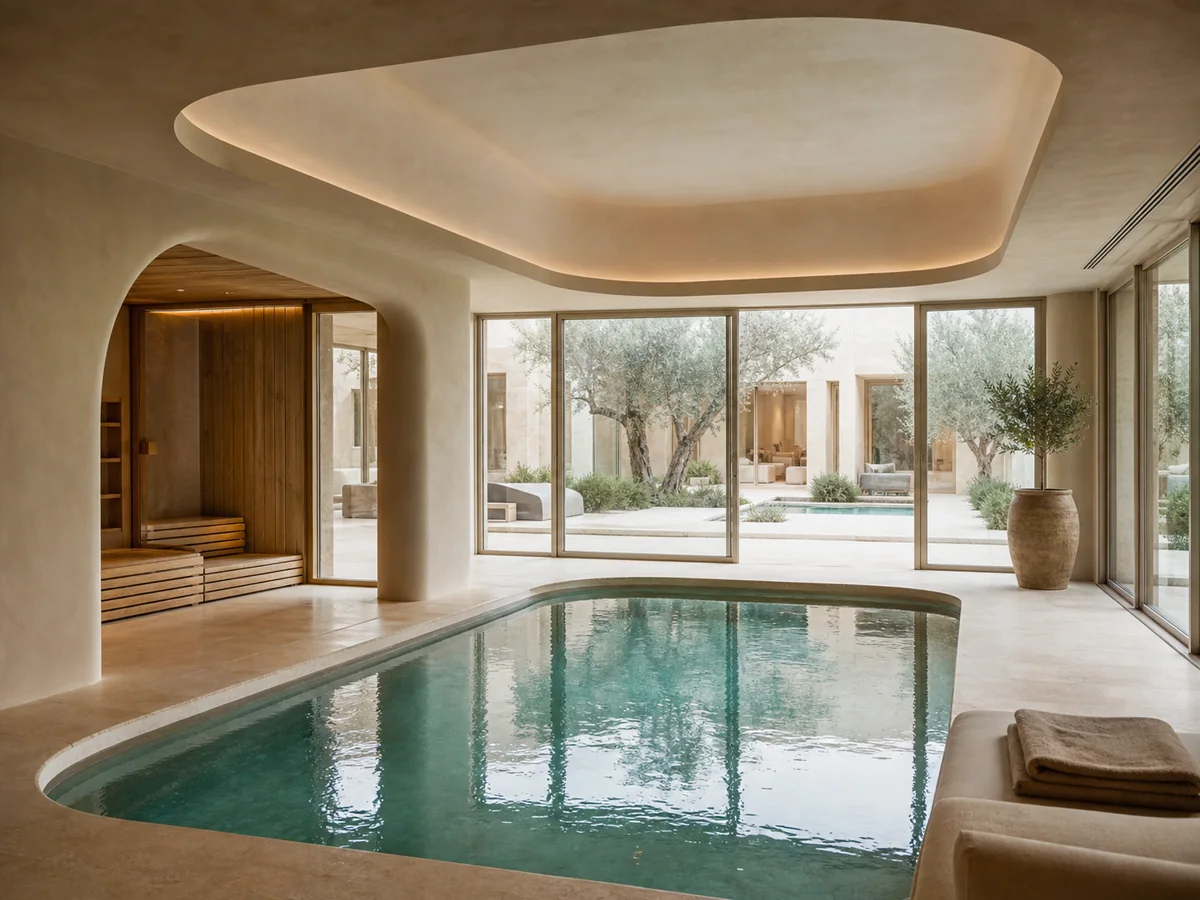 04
04Company & Contact
To talk about your project, we are one call away.
Legal Name
Çilek Havuz
Founded
1998 · Istanbul
Head Office
Çilek Plaza, Eyüp Sultan Mah. Yakacık Cd. Feshane Cd. No: 2 D:4 D:1, 34885 Sancaktepe / İstanbul
Service Area
All of Türkiye · exports to 14 countries
Related articles
Keep reading.
Sık Sorulan Sorular
Our readers' most asked; with expert answers.
Çilek Havuz Content & Technical Team
Guides & Technical Content
- Response Time
- Same day
- Channels
- Phone · E-mail · WhatsApp
If the answer you are looking for is not here, send your question directly to us and our team will reply as soon as possible.
Book a free site surveyIn indoor pools, relative humidity is kept within a comfortable range to prevent condensation and excessive evaporation; This balance is constantly maintained with a dehumidification unit specifically sized for the location. When the humidity remains below the target, evaporation and energy consumption increases, and when it is exceeded, the risk of mold begins. Correct device capacity and air distribution are key to this balance.
Çilek Havuz Content & Technical Team
Indoor pool air is much more aggressive than in ordinary structures due to chlorine compounds and high humidity; This environment wears out metal, paint and fasteners that are not resistant to corrosion over time. For this reason, profiles, gaskets and ceiling elements are selected resistant to moisture and chlorine. Choosing the right material from the beginning is essential for a long-lasting facility.
Çilek Havuz Content & Technical Team
Large glass facades bring natural light into the space and maintain the feeling of open air even in a closed volume; However, since glass is the thermally weakest link of the structure, solutions with high insulation performance are required. The balance between light need and heat loss is established by planning the glass surface ratio and direction. This balance requires the architectural and mechanical teams to work together.
Çilek Havuz Content & Technical Team
Lighting in the indoor pool is planned to include both natural light during the day and artificial lighting at night; Corrosion-resistant fixtures suitable for humid and chlorinated environments are preferred. The placement reduces reflections and glare on the water surface and increases comfort. Maintenance access for lighting fixtures is also taken into account in the design.
Çilek Havuz Content & Technical Team
Sound reflection may be high in indoor pool areas where hard and moist surfaces predominate; This reduces comfort. Moisture-resistant acoustic surface solutions make the space more useful by reducing echo. Since acoustics is an issue that is often noticed late, we recommend that it be addressed at the design stage.
Çilek Havuz Content & Technical Team
It is important that dehumidification and basic climate control are not stopped completely, even during periods when the pool will not be used for long periods of time; otherwise condensation and mold can silently damage the structure. Covering the water surface with a cover reduces evaporation and heat loss. A low-paced operating mode preserves both energy and structure.
Çilek Havuz Content & Technical Team