

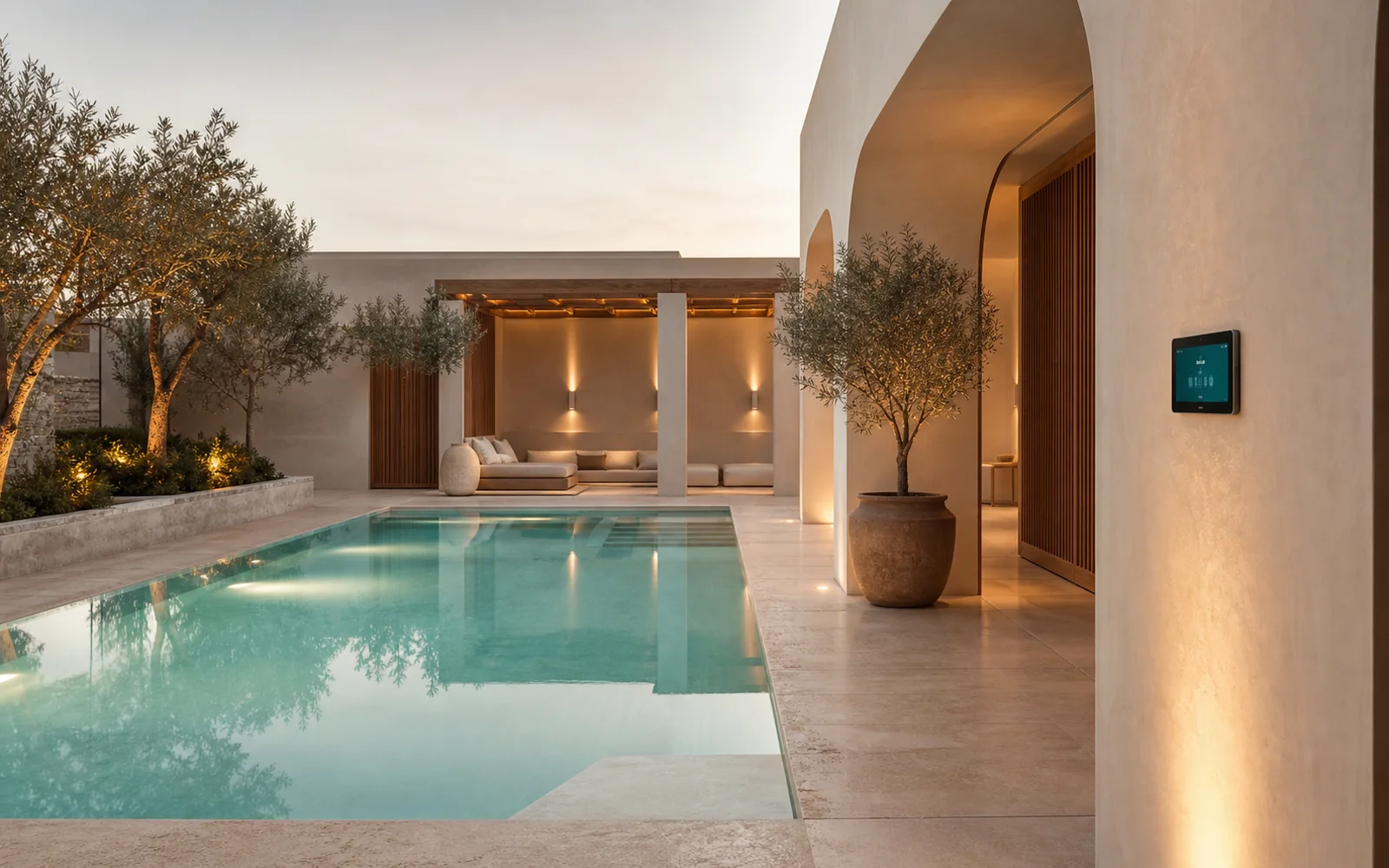
Pool Automation: Smart Control and Remote Management
A modern pool is no longer just water and mechanical equipment; it is a smart system that links dosing, pumps, filtration and lighting together. Pool automation stabilizes water quality, uses energy efficiently and lets you manage your pool from the palm of your hand.
A modern pool is no longer just water and mechanical equipment; it is a smart system that links dosing, pumps, filtration and lighting together. Pool automation stabilizes water quality, uses energy efficiently and lets you manage your pool from the palm of your hand.
Pool automation is a system that automates all traditionally manual processes through sensors, control units and software. There are many variables that must be constantly monitored and adjusted for the healthy operation of a pool: the chemical balance of the water, filtration cycles, circulation flow rate, water temperature and lighting. Automation is the structure that combines these variables under a single intelligence rather than being independent devices.
At the heart of this combined structure are sensors that read the current status of the pool. Sensors continuously measure water chemical values, temperature and flow conditions; The control unit evaluates this data and makes the necessary interventions automatically. Pool maintenance thus relies on seamless, data-driven management, rather than on manual measurements and guesswork settings several times a day.
Our experience in pool engineering since 1993 has shown that the greatest value of automation is consistency. Fluctuations that are inevitable in human-managed maintenance are eliminated with automation. Water is kept in the same balance throughout the day and night; equipment operates exactly as needed; Both water quality and energy use are fixed at the most optimum point. Automation turns the pool from a burden into a manageable system.
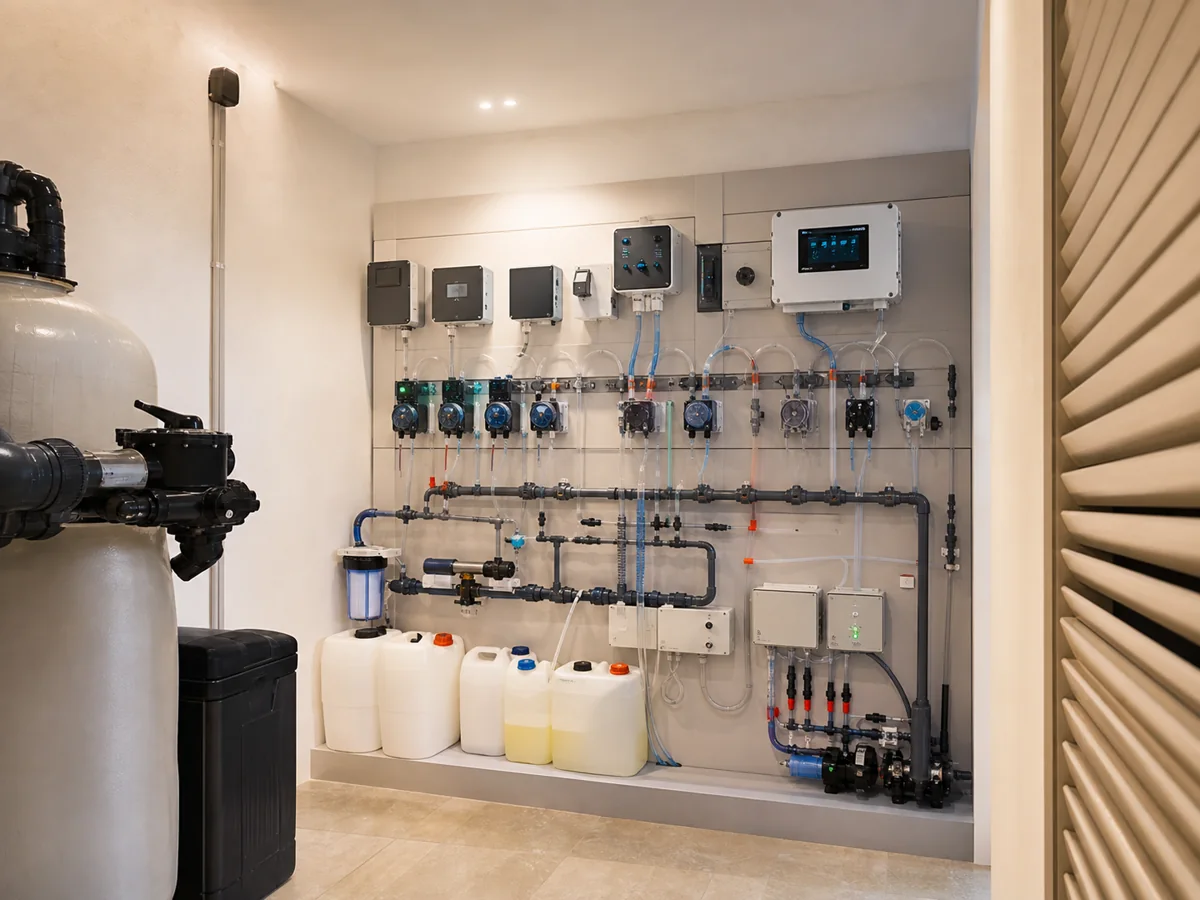
The most critical component of pool automation is the dosing system. Water quality, disinfection level and acid-base balance of the water are decisive for both the hygiene and comfort of the pool. When these values are not kept in balance, the water is either not disinfected sufficiently or problems such as eye-skin irritation, equipment corrosion and surface damage occur. The automatic dosing system is the structure that constantly maintains this delicate balance without the need for human intervention.
The system reads the disinfectant level and acidity value in real time through measurement probes placed in the water. When measured values fall outside the target range, dosing pumps automatically add the exact amount of chemical to the water. This measurement-evaluation-intervention cycle works continuously; Water values remain stable throughout the day and chemical consumption is reduced to the amount needed. This means both healthier water and a more economical business.
One of the most important contributions of automatic dosing is safety. Manual addition of chemicals is both difficult in terms of getting the right amount and poses risks when storing and mixing chemicals. Automation minimizes chemical contact and prevents overdosing. Since the system constantly monitors the probe values, it gives warnings in case of unexpected deviations; This way, a problem is noticed before it gets bigger. An on-site dosing automation is the invisible but most valuable assurance of the pool.
The largest share in a pool's energy consumption belongs to the circulation pump, which constantly circulates the water. Conventional fixed-speed pumps always run at full power, regardless of need; This often means spending more energy than necessary. The most tangible savings area of intelligent automation emerges here, in variable speed pump technology.
Variable speed pumps can adjust their speed according to the current need. When it is sufficient to circulate only the water of the pool for filtration, the pump operates at a low and quiet speed; It increases its power in situations requiring high flow rate. Since the relationship between pump power and energy consumption is non-linear, a slight reduction in speed provides a much greater reduction in energy consumption. Automation makes this savings permanent by managing the pump according to the actual need during the day.
On the filtration side, automation optimizes washing and maintenance cycles by monitoring filter performance. By monitoring the pressure change on the filter, the system can determine when the filter needs to be cleaned; Thus, the filter is not taken into service either too early or too late. Coordinated operation of circulation, dosage and filtration under a single automation ensures that each equipment is activated to support the other. This integrated management maximizes both water quality and energy efficiency simultaneously.
The most visible benefit of pool automation to the user is the possibility of remote control. Thanks to IoT, that is, internet of things technology, all systems of the pool are connected to an application over the internet. In this way, you can monitor and manage your pool's water temperature, chemical values, pump status and lighting from your phone wherever you are.
The practical value of this connection is great. You can turn on the pool lighting before returning home, pre-set the water temperature for an evening when guests will arrive, and make sure that the chemical balance of the pool is maintained while you are on vacation. The system notifies you when there is a deviation in the values; This way, you can detect a problem without being at the pool and intervene remotely if necessary. Pool management transforms from a job requiring physical presence to a system that can be monitored remotely.
The industry's leading manufacturers offer powerful solutions in this field. Automation and IoT platforms from brands such as Astral allow you to manage dosing, pumps, filtration and lighting in an integrated manner through a single application. These platforms establish a common language that allows different equipment to talk to each other; Thus, the pool becomes a single intelligent system managed end-to-end, rather than a collection of disconnected devices. Establishing these ecosystems correctly during the project phase ensures that automation can be expanded and updated in the future.
Beyond safety and function, pool lighting is a powerful design tool that determines the nighttime identity of the space. With automation, lighting ceases to be a singular on-off function and turns into scenarios. Predefined lighting scenes according to different times, uses and moods can completely change the atmosphere of the pool with a single touch.
LED systems that can change color stand out in modern pool lighting. The color, brightness and transition rhythm of these lights can be programmed through automation. Soft and calm lighting for a quiet evening, a lively and colorful scene for a celebration, clear and sufficient lighting for security; they are all predefined and called instantly when desired. When lighting scenarios are designed together with the landscape and architectural lighting around the pool, the entire space turns into a composition.
Automating lighting scenarios also provides energy and time management. The lights can be timed, can be activated automatically according to sunset, and can be dimmed automatically during unused hours. With remote control, these scenarios can be activated without you being at the pool. Thus, lighting becomes both an aesthetic experience and an intelligently managed system that does not waste its energy. In all of automation, lighting is the most visible example of how technology transforms comfort into beauty.
Pool automation is a system decision, not a device purchase. The most common mistake is to see automation as an accessory to be added after the pool is completed. However, dosing probes, sensor locations, cabling, control unit location and the communication infrastructure of the equipment give the most efficient results only when they are designed together with the pool project. Planning automation from the beginning prevents incompatibilities and cost increases caused by solutions added later.
Proper automation planning starts with understanding your pool's usage pattern. How often it is used, how many people it serves, whether it is open or closed, and how involved you want to be in management determine the scope of the system. While a fully autonomous system that requires no intervention is right for some users, a structure that balances remote monitoring and manual control is more suitable for others. The scale of automation should be determined according to the need.
Another critical issue is the system's future extensibility. An automation established today should be able to grow over the years with new equipment, additional scenarios or updated software. That's why we prefer updatable platforms built on open and widespread ecosystems. When planning your pool automation project, establishing an infrastructure that takes into account not only today's needs but also what technology will offer in the coming years will preserve the value of your investment for a long time.
Image gallery
04 görsel
 01
01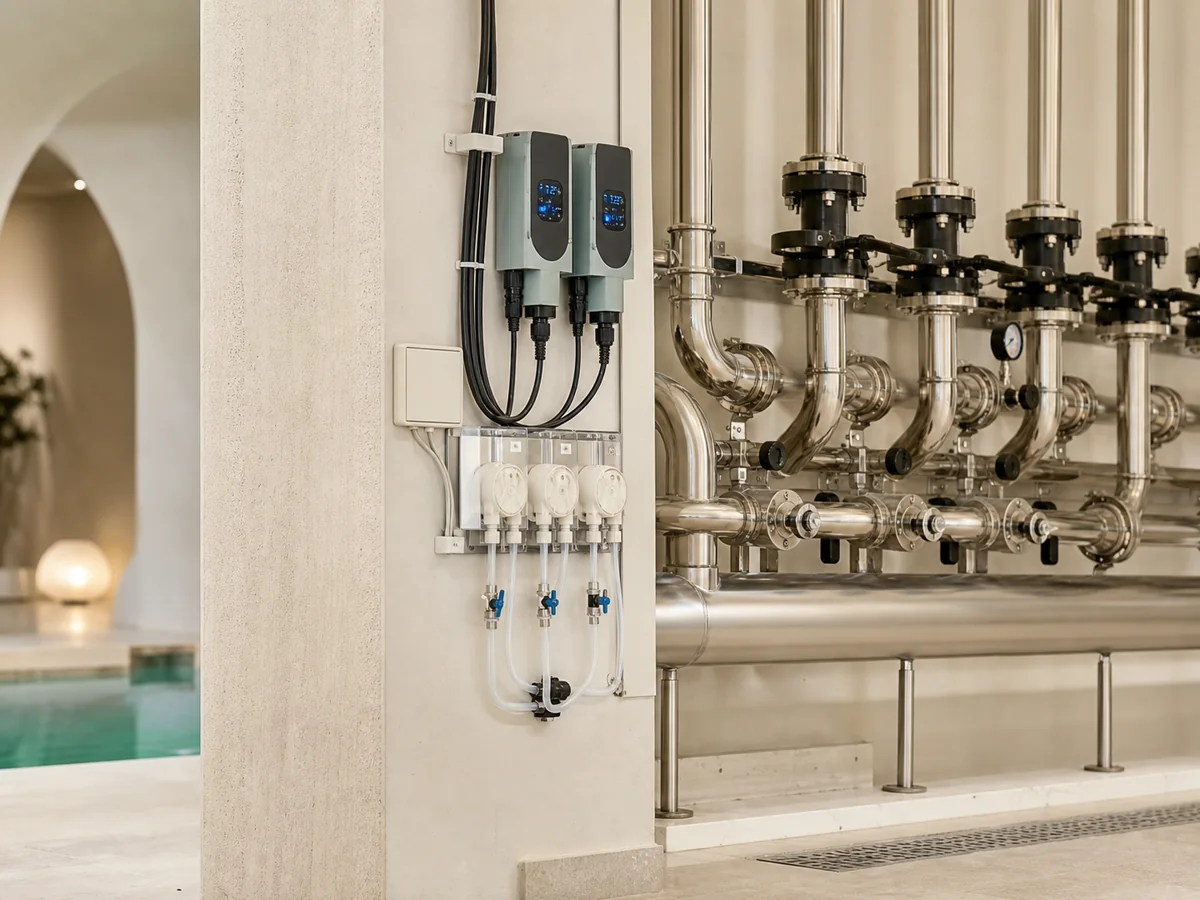 02
02 03
03 04
04Company & Contact
To talk about your project, we are one call away.
Legal Name
Çilek Havuz
Founded
1998 · Istanbul
Head Office
Çilek Plaza, Eyüp Sultan Mah. Yakacık Cd. Feshane Cd. No: 2 D:4 D:1, 34885 Sancaktepe / İstanbul
Service Area
All of Türkiye · exports to 14 countries
Related articles
Keep reading.
Sık Sorulan Sorular
Our readers' most asked; with expert answers.
Çilek Havuz Content & Technical Team
Guides & Technical Content
- Response Time
- Same day
- Channels
- Phone · E-mail · WhatsApp
If the answer you are looking for is not here, send your question directly to us and our team will reply as soon as possible.
Book a free site surveyIn a well-designed automation, an internet outage does not stop the local control unit from working; The system continues its basic cycles locally, only remote access is temporarily interrupted. It is important to protect critical alerts and programs against power outages. Planning these scenarios at the project stage increases the reliability of the system.
Çilek Havuz Content & Technical Team
Measurement probes require regular calibration and cleaning as they can lose sensitivity over time; A probe that is out of calibration may misdirect the dosage by making the system read the wrong value. Maintenance frequency varies depending on the intensity of use and water conditions. Probe maintenance is one of the most critical routines for the correct operation of automation.
Çilek Havuz Content & Technical Team
Integrated management depends on equipment being able to communicate in a common language; For this reason, platforms built on open and widespread ecosystems are preferred. Although it is possible for different brands to work together, compatibility should be verified from the beginning. Platforms like Astral offer solutions that facilitate this integrated management.
Çilek Havuz Content & Technical Team
An open and extensible infrastructure should be preferred so that an automation system established today can grow with new equipment, additional scenarios and updated software over the years. A closed and narrow system makes future additions difficult. Therefore, when planning the investment, we recommend that you take into account not only today's needs but also the needs of the coming years.
Çilek Havuz Content & Technical Team
Automation greatly reduces the daily measurement and dosing burden, but periodic expert support for tasks such as probe calibration, mechanical inspection and seasonal maintenance is still valuable. The system automates the routine; Human control remains complementary in the evaluation of unforeseen situations. The most efficient result is achieved by combining automation with regular technical control.
Çilek Havuz Content & Technical Team
Since the applications that manage your pool remotely connect over the internet, it is important to use strong passwords and follow the platform's security updates. Platforms of well-established manufacturers offer infrastructures that provide this security. We recommend that you only share app access with people you trust.
Çilek Havuz Content & Technical Team