

Pool Chemical Dosage: A Cubic-Meter Guide to Chlorine, pH and Algaecide
Berrak-looking water can still be unbalanced. Learn how to calculate chlorine, pH and algaecide dosage based on your pool's volume in cubic meters, the correct order of treatment, and how to avoid the invisible trap of chlorine lock-out, explained with engineering clarity.
Berrak-looking water can still be unbalanced. Learn how to calculate chlorine, pH and algaecide dosage based on your pool's volume in cubic meters, the correct order of treatment, and how to avoid the invisible trap of chlorine lock-out, explained with engineering clarity.
Assuming water is safe simply because it looks clear is the most common pool maintenance mistake. Chemical imbalances—such as depleted chlorine, pH drift, or high combined chloramines—cannot be seen until biological fouling or bather irritation has already developed. Since 1993, we maintain that water quality is protected by measurable chemistry, not good intentions.
Accurate dosing begins with knowing your pool water volume in cubic meters (m³): length × width × average depth for rectangular pools. For example, an 8m × 4m pool with 1.5m average depth holds 48 m³ of water. Every chemical dosage calculation is anchored to this baseline volume.
Active ingredient concentrations vary across chemical formulations (e.g. 56% vs 90% stabilized chlorine). Always read package labels alongside standard dosing guidelines to calculate exact gram amounts.
The target free chlorine concentration for private pools is 1.0–3.0 ppm (mg/L). Concentrations below 1.0 ppm result in inadequate disinfection, while levels above 3.0 ppm cause eye and skin irritation. Aiming for 1.5–2.0 ppm is the ideal operational sweet spot for most pools.
In routine chlorination, raising free chlorine by 1.0 ppm requires approximately 15–18 grams of 56% sodium dichlor granules per 10 m³ of water. For a 48 m³ pool, raising chlorine by 1 ppm requires roughly 75–85 grams. During hot summer peaks, test water daily at sunset when UV degradation stops.
Shock (superchlorination) elevates chlorine to 5.0–10.0 ppm to eliminate refractory chloramines, bacteria, and algae spores. Shock dosing uses 10–20 grams of rapid-dissolving chlorine per m³, applied at dusk with continuous filtration overnight. Never swim until chlorine drops below 3.0 ppm.
pH measures water's acid-base equilibrium and acts as the master regulator of pool chemistry. The target range is strictly 7.2–7.6. Outside this band, chlorine efficacy drops precipitously: at pH 8.0, chlorine loses over 50% of its sanitizing power. Dosing chlorine without balancing pH first is like carrying water in a perforated bucket.
When pH rises, pH Minus (sodium bisulfate or dilute acid) is dosed. As a baseline rule, lowering pH by 0.2 units in 10 m³ requires roughly 100–150 grams of pH Minus, depending on total alkalinity. When pH is low, pH Plus (sodium carbonate) is added. Circulate water 4–6 hours before re-testing.
Total Alkalinity (TA) must be monitored alongside pH; the target range is 80–120 ppm. Alkalinity acts as the chemical buffer stabilizing pH: when TA is balanced, pH remains steady; when TA is low, pH fluctuates wildly. Stabilize alkalinity first to lock in pH.
Algaecide is a preventative barrier, not a standalone cure. Once active algae bloom establishes, algaecide alone cannot clear it; its function is inhibiting algae spores from germinating. Algaecide must be used as a routine weekly preventative.
Standard preventative maintenance dosing is 3–5 ml of non-foaming algaecide per m³ weekly (approx. 150–250 ml weekly for a 48 m³ pool). A higher initial dose (8–10 ml/m³) is applied at spring opening. Dose algaecide with pumps running for uniform distribution.
Always specify non-foaming algaecides; low-grade products create persistent surface foam and oil sheens. AstralPool chemical lines provide concentrated, non-foaming algaecides engineered for luxury and commercial pool applications.
Chemical sequencing is just as critical as dosage. Adding chemicals in the wrong sequence can neutralize active ingredients or produce dangerous chemical reactions. The correct protocol: first balance Total Alkalinity and pH; once water stabilizes, dose chlorine; and finally add algaecides or clarifiers.
Never mix different dry or concentrated liquid chemicals together. Always add each chemical separately directly into the pool over return jets with the pump running, allowing at least several hours between treatments.
Always add chemicals to water, never water to concentrated chemicals. Dissolving granular products in a clean bucket of pool water prior to distribution prevents concentrated granules from settling onto and bleaching PVC liners or colored mosaic grout.
If you add chlorine continuously but test kits consistently show zero free chlorine while water smells pungent, your pool is likely experiencing 'chlorine lock.' The primary culprit is excessive cyanuric acid (CYA), the stabilizer used in trichlor tablets.
While ideal CYA is 30–50 ppm to protect chlorine from sunlight UV breakdown, levels exceeding 80–100 ppm over-stabilize the water, binding chlorine so tightly that it can no longer disinfect. Stabilized tablet users inadvertently build up CYA because stabilizer never evaporates.
There are no chemical removers for cyanuric acid; the only solution is draining a portion of pool water and refilling with fresh water. Prevent chlorine lock by alternating stabilized tablets with unstabilized liquid chlorine and testing CYA monthly.
Even perfect dosing calculations fail if testing is inaccurate. Always collect water samples at elbow depth (approx. 40 cm below surface) away from return jets and skimmer mouths; surface water does not reflect bulk water chemistry.
Chemical reagents degrade over time; replace test tablets and liquid reagents annually and store testing kits in a cool, dark cabinet. DPD photometers or liquid drop kits provide far greater precision than test strips for critical balancing.
Never test immediately after adding chemicals; allow 4–6 hours of continuous filtration for complete homogenization. Testing prematurely leads to false readings and accidental double-dosing.
Image gallery
04 görsel
 01
01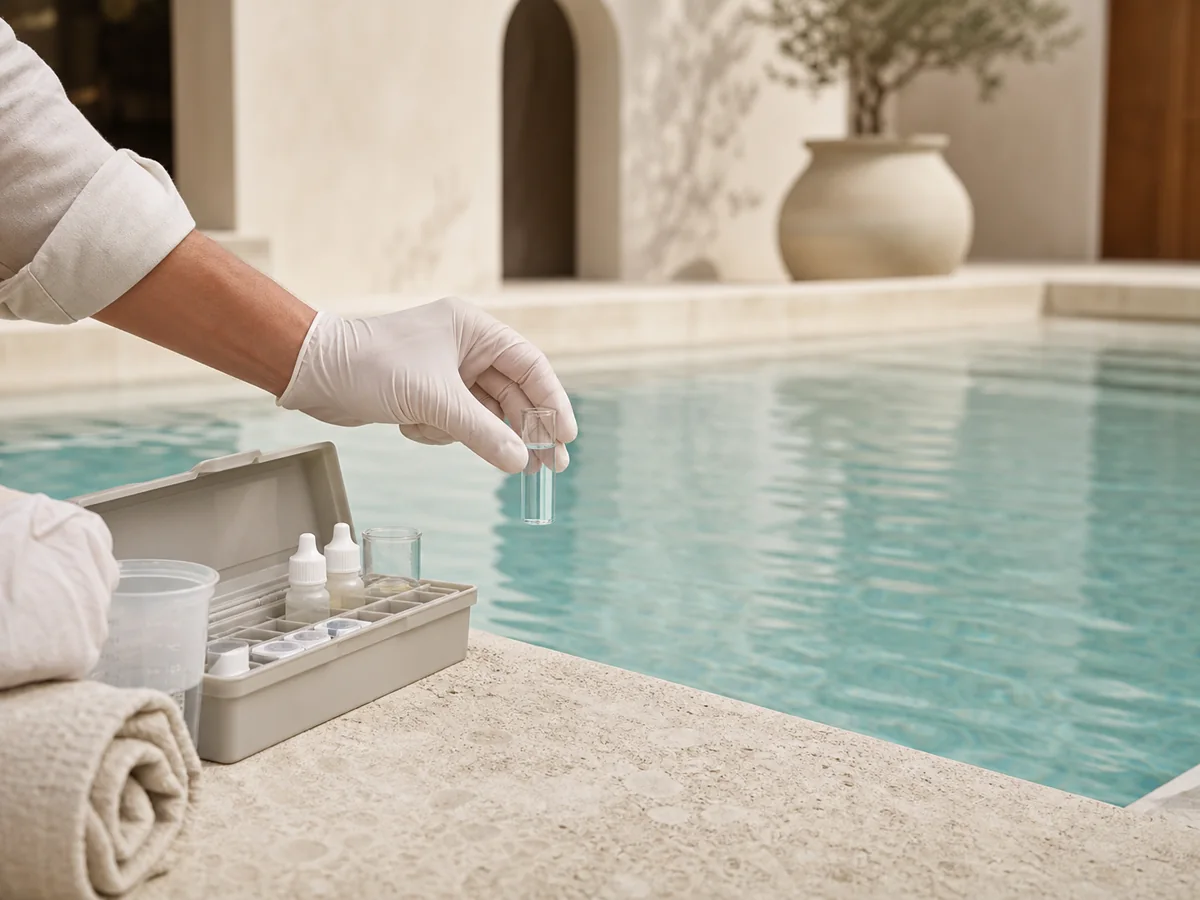 02
02 03
03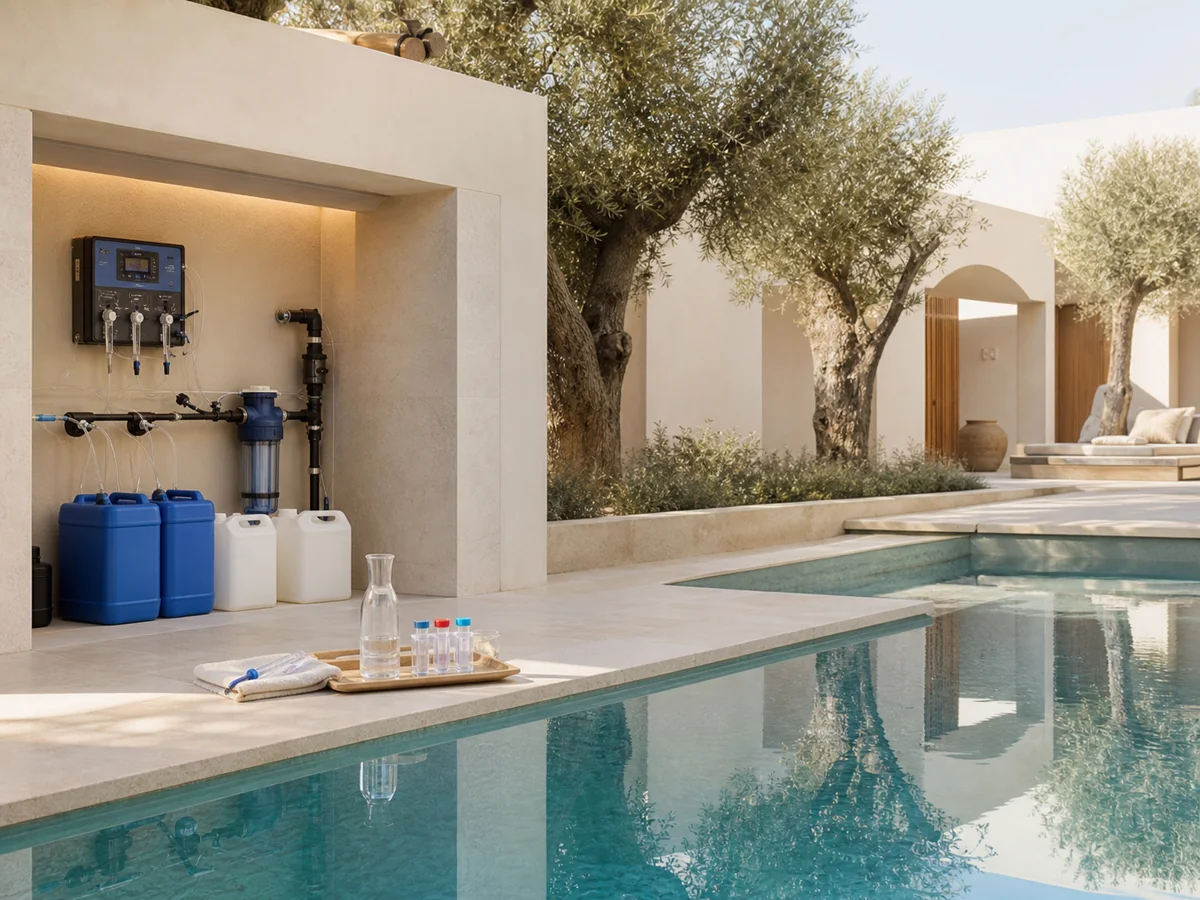 04
04Company & Contact
To talk about your project, we are one call away.
Legal Name
Çilek Havuz
Founded
1998 · Istanbul
Head Office
Çilek Plaza, Eyüp Sultan Mah. Yakacık Cd. Feshane Cd. No: 2 D:4 D:1, 34885 Sancaktepe / İstanbul
Service Area
All of Türkiye · exports to 14 countries
Related articles
Keep reading.
Sık Sorulan Sorular
Our readers' most asked; with expert answers.
Çilek Havuz Content & Technical Team
Guides & Technical Content
- Response Time
- Same day
- Channels
- Phone · E-mail · WhatsApp
If the answer you are looking for is not here, send your question directly to us and our team will reply as soon as possible.
Book a free site surveyBoth serve distinct purposes: granular chlorine (dichlor) dissolves rapidly for quick level adjustments and shock treatments, while slow-dissolving trichlor tablets provide continuous maintenance in skimmers or erosion feeders. Alternating them prevents excessive cyanuric acid accumulation.
Çilek Havuz Content & Technical Team
Wait until free chlorine returns to the safe 1.0–3.0 ppm range and water has completed at least one full circulation turnover; following shock chlorination, this may take 12–24 hours. Always test water before swimming.
Çilek Havuz Content & Technical Team
Total Alkalinity serves as the pH buffer. If TA is below 80 ppm, pH will fluctuate erratically with every bather or rainfall. Correct TA to 80–120 ppm using sodium bicarbonate first; pH adjustments will subsequently remain stable.
Çilek Havuz Content & Technical Team
Intense solar UV radiation breaks down free chlorine, while higher water temperatures and bather sweat accelerate organic loading and bacterial reproduction. Testing daily at sunset and maintaining optimal stabilizer levels mitigates summer chlorine loss.
Çilek Havuz Content & Technical Team
The issue is not brand names, but chemical compatibility and active ingredient concentrations. Never mix dry chemicals in the same bucket or feeder; always add products individually into circulating pool water.
Çilek Havuz Content & Technical Team
DPD drop kits and digital photometers provide high accuracy when reagents are fresh. Test strips are convenient for quick daily screening but have wider tolerances. Replace testing reagents at the start of each season.
Çilek Havuz Content & Technical Team